Biblioshelf Musings: Atomic Habits

Yoohoo Bibliofriends!

This week’s Biblioshelf Musing is from a non-fiction self-development style book called Atomic Habits. This is by far one of the most useful books I have ever read (listened to). I originally purchased it as a friend had rated it 5 stars and referred to it on one of those ‘books that saved my life’ tweets.


Book: Atomic Habits by James Clear (Audiobook)
Genre: Non-Fiction, Self-Help: Personal Development
Publication Date: 18th October 2018
Publisher: Penguin Random House Audiobooks
Pages: N/A
Rating: 📚📚📚📚📚

Synopsis (from Goodreads)

In this highly practical guide, today’s leading expert on habit formation lays out a proven system for making good habits inevitable and bad habits impossible.

Atomic Habits asks a simple but powerful question: How can we live better? We know good habits build better lives, but it’s easy to get thrown off course–trying to lose weight when we eat poorly and sleep too little; spending when we want to save. What makes some habits easy to stick with while others fail?

Filled with self-improvement tips based on proven scientific research, Atomic Habits reveals how altering our small daily habits can transform our lives for the better. This easy-to-understand guide uncovers the hidden forces that shape your behavior–everything from mindset to environment to genetics–and shows you how to take control of them. Organized around the Four Laws of Behavior Change, this book will show you how to apply each one to your life and work. In the end, you’ll get a simple method for building a repeatable and sustainable system for success.

James Clear, author of a wildly popular blog with more than two million readers per month, is known for his ability to distill complex topics into an easy-to-understand format. Now, he breaks down the art and science of habit formation into its most fundamental state, giving us a playbook for success. Sharing stories of his own achievements alongside those of star athletes, business leaders, artists, people who have kicked addiction against all odds, and even folks who just wanted to stop biting their nails, Clear proves that your goals are within reach–as long as you start small.

If you want to transform your habits–or those of your family, team, or community–then you want to read this book.


Now I have to confess, during the lockdown, my reading of physical books massively increased so I kind of forgot that this audiobook existed for a while and ended up parking it on a digital shelf having only listened to a small portion. Since the Monday-Friday work resumed at school and the pressures of teaching life unfolded, the motivation to try and get through some of the already unfinished books resurfaced and I decided to try and make it a habit to resume the listening of my audiobooks.

Atomic Habits is told in a clearly structured way surrounding the ‘4 laws’ for good habit-making. Each chapter takes you through the strategies of how to develop a good habit and then the book gradually builds up chapter by chapter into how to ingrain those good habits seamlessly into your lifestyle. The chapter summaries at the end repeat the key themes and actions to take forward and almost forms as a workbook or step-by-step guide into what you need to do next to make your own atomic habits a reality. The benefit of having this as an audiobook was that listening to those steps being repeated over and over again made them get stuck in my head almost like the way you can recall the lyrics to your favourite songs.

Clear also goes a step beyond just the formulation of habits and habit strategies by detailing some of the underlying scientific principles to explain how habit formation works in your brain and how to develop good habit behaviours/disciplines in your life. Coupling this with case notes of famous celebrities or renowned organisations (Steve Martin, British Cycling Team, Katie Ledecki) as well as ordinary people in high-powered business jobs, Clear gives first-hand examples of how habit-building and application can lead you into creating a more successful or proactive lifestyle. While listening, my mind was automatically zooming into the type of habits I could be using within both my personal life and at school.

After finishing this book, I’ve definitely been applying some of the strategies I’ve learned into my life. I’m starting (as recommended) with smaller achievable habits which I can then ‘habit-stack’ into hopefully ticking off some of my goals. As a stationery addict of course this has come complete with pretty notebook, colour-coding pens and highlighters, stickers and washi tape etc… At the minute, I’m definitely feeling more motivated now that I’m taking some proactive steps into living more of a productive life (us Taureans do have laziness listed as one of our character traits…!). Time will tell whether or not those atomic habits start to just become part of the normal daily life.

If there are elements of your life or world which you wish were more successful or you want to feel more content with then I strongly recommend buying and reading this book. If you’re even wavering over it, a really good place to start would be James Clear’s website which contains a great deal of information about the book and also features some excerpts and chapters to give you a flavour of what it’s like. I am definitely looking forward to putting what I’ve learned into practice. One of the habits I really want to build upon is my engagement with other blogs and people on Book Twitter so those have now been factored into my habit tracker. There’s also a few health/personal elements that I’m working on such as making sure I text one different friend each day, just to check-in on them and say hello (I’m quite at bad at that!). Fingers crossed that it starts to work – I’ll have to update you in my July update to see if it’s working. Here’s to a more habit-centred, productive lifestyle!

James Clear WebsiteAmazon | Waterstones |


Do you feel like you need little more order in your life? What bad habits are you guilty of committing? What kind of good/productive habits would you put into your habit-tracker? As always, drop me a comment to chat!

T xx
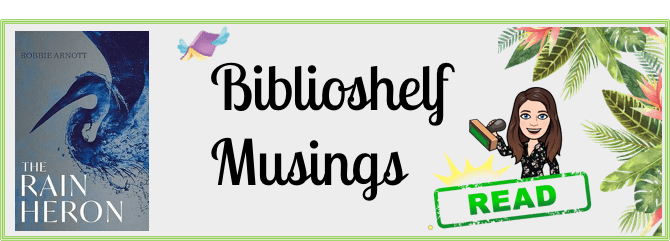
Biblioshelf Musings: The Rain Heron

Hey Bibliofriends! Happy 1st July!

This week’s Musings come from a wonderful book I recently acquired through NetGalley called The Rain Heron. Although it contains a serious message, a little magic and mythology are interwoven through its narrative and I absolutely adored it!


Book: The Rain Heron by Robbie Arnott
Genre: Literary Fiction
Publication Date: 2nd July 2020
Publisher: Atlantic Books
Pages: 304
Rating: 📚📚📚📚📖

Synopsis (from Goodreads)

Ren lives alone on the remote frontier of a country devastated by a coup. High on the forested slopes, she survives by hunting and trading – and forgetting. But when a young soldier comes to the mountains in search of a legendary creature, Ren is inexorably drawn into an impossible mission. As their lives entwine, unravel and erupt – as myth merges with reality – both Ren and the soldier are forced to confront what they regret, what they love, and what they fear.

A vibrant homage to the natural world, bursting with beautiful landscapes and memorable characters, The Rain Heron is beautifully told eco-fable about our fragile and dysfunctional relationships with the planet and with each other, the havoc we wreak and the price we pay.


The Rain Heron is a stunningly decadent tale of mythical creatures and the price our humanity pays on the natural world. Billed as an ‘eco-fable’, the story of The Rain Heron is centered around a legendary bird made of water that can affect the weather of the land surrounding it – and by proxy, the impact that has on humans. The story follows Ren, a woman who lives and forages in the forests, and Lieutenant Harker who has been charged with finding and capturing the heron.

From the outset, the vivid language and opulent vocabulary woven through the pages makes for an atmosphere rich in imagery. I loved the tone of the storytelling and felt as though my senses were heightened as I witnessed Arnott’s landscape inside my brain in HD technicolour.

Being told through four non-linear parts of differing perspectives enables the reader to explore the various personality traits of the main characters and see their unique interpretations and views of the world. Although each character has different motivations, the main message is crystal clear – looking after nature is everyone’s responsibility and we all need to do our bit to prevent the disastrous ramifications that its desolation will bring upon our planet.

I have to admit, when Part Two hit, I did wonder if this were more a compilation of tales rather than just one story but by sticking with it and moving on to the remaining parts, the story neatly weaves itself together and further explains certain characters’ justifications for their actions. This notion of consequence is seen mostly through Lieutenant Harker (whether she is directly affected or an observing bystander) and I really enjoyed the way her character arc changed and developed throughout her journey in the story.

I’d love to think that a rainbow heron existed once upon a time. The bird itself is a powerful symbol within the book and gave the novel a parable feeling – almost like an ancient myth you would use to explain to children where rain comes from. The quest for the legendary creature made me feel as if I was reading the adult Pokémon novel I’ve been waiting for all my life mixed in with a highly poignant ecological sentiment.

Arnott has a standout voice and has spun such a timeless, relevant novel for our times. I found it deeply moving and it really made me consider the balance we need to find between our human world and our natural world. Rather than keep taking from nature, we need to find ways in which we can give back and preserve the heritage of our air, lands, seas and all creatures great and small for future generations. If you love tales from the environmental world which resonate a true, meaningful mantra then you need to take a leap into the world of The Rain Heron!

Big thanks to NetGalley, Atlantic Books and Robbie Arnott for providing me with a free copy in exchange for an honest review.

Atlantic Books | Waterstones | Amazon |


What’s your favourite ecological tale? Do you have a favourite myth or legendary creature? Would you like to live in a world where Rain Herons could exist? As always, drop me a comment to chat!

T xx

Biblioshelf Musings: My Fence is Electric: and Other Stories

Happy last Wednesday in June Bibliofriends!

Short stories are an art of their own. To do it well is some achievement, but to do it so well that it becomes powerful enough to leap off the page into your bookish heart is something else entirely… It’s safe to say that Mark Newman is a master of the short story art form.

My Fence Is Electric: and Other Stories is an anthology full of award-winning stories that deal with a lot of the macabre sentimentalities of everyday human existence. Dysfunctional families are actually quite normal nowadays; we don’t always know what goes on behind closed doors; many of us have parts of ourselves that we’d rather change or adapt. In places, Newman writes parables of bygone childhoods for reminiscent adults – others form as eerie ghost stories of the living – literary brilliance right up my street!


Book: My Fence is Electric: and Other Stories by Mark Newman
Genre: Short Stories
Publication Date: 18th February 2020
Publisher: Odyssey Books
Pages: 162
Rating: 📚📚📚📚📖

Synopsis (from Goodreads)

A housing estate is in shock following a child’s disappearance. A girl and her invisible friend go their separate ways. A father and a son bond over Post-It notes. A single father and his daughter have different approaches to the disappearance of their dog. A father finds his way to coax his agoraphobic son back out into the world.

My Fence is Electric and Other Stories is a collection of award-winning short stories looking at those moments in life that fizz with the electric intensity of change.


Many big themes (love, hope, freedom, conservation, illness, tragedy and change) are represented in these stories and Newman has such a wonderful way with words and descriptions; it really appealed to the inner logophile within me. Here are some of my personal favourites:

Before There Were Houses, This Was All Fields – Living in a rural area, I can relate majorly to our fields turning into building sites. This story opened Newman’s collection in a way which sets the tone for the whole compilation. The spooky imagery of the fairytale street names followed by evil and the likening of houses to skulls with their concrete breeze blocks and no windows for eye sockets was exceptional. You’re reminded that this story could so easily have been something you watch on the evening news. In a world with an expanding population and increasing housing need it’s an apt nod to what humanity has concreted over.

Little Yellow Squares discusses the way we can be talking about the same thing but really be having two entirely different conversations – all I can say is, I wish my post-it notes did what they do in this story!

We Sink When We Swim – I love the symbolism of the swimming pool in this story. The way it represents a journey, growing old, being lonely and the metaphorical way it considers what is really beneath the surface of the water and our emotions.

Butterfly Farm – So short yet so sweet. Without spoilers, I love the way the way freedom is represented and parodied between the butterflies and ‘she’.

My Fence is Electric focuses on the way we try to protect ourselves from heartbreak, I’ll never look at an electric fence again without thinking of this story.

Rosa is Red, Violet is Blue centres around our identities, how we strive to be someone different and the change we want to bring about in ourselves. I enjoyed the way the colours represented differing attitudes and personality traits.

I read My Fence is Electric: and Other Stories during the coronavirus lockdown and it strikes me as the perfect ‘stay-at-home’ book to remind you of ‘real people’ during this time when we can’t see our friends and families as we usually would. It’s a reminder that we are all unique, we all have little worlds inside our own heads, yet we are all out here on planet earth trying to survive through this together whilst being socially distanced and apart. In my own little way, the stories reminded me slightly of a bookish version of my favourite Florence + the Machine songs, probably another reason why I thoroughly enjoyed it. This collection really does have something for everyone, you can dip in and out of the stories at any time or read them through in their published entirety.

When I think of the greats of the short story genre, I often think of the renowned anthologies: Raymond Carver’s What We Talk About When We Talk About Love; Katherine Mansfield’s The Garden Party and Other Stories; Angela Carter’s The Bloody Chamber – I will now definitely be adding Mark Newman’s My Fence Is Electric: and Other Stories onto that list as well – it deserves its place there.

A big thank you to Odyssey Books for getting in contact with me via Twitter and providing me with a free copy of this book in exchange for an honest review. An extra big THANK YOU to Mark Newman for bringing these incredible stories into my life! ☺️

Even if you don’t normally read short stories, there is bound to be something for you in this collection – I would wholeheartedly recommend you read it!

Odyssey BooksAmazon | Waterstones |


What’s your favourite short story ever? Do you prefer longer short stories or short short stories? As always, drop me a comment to chat!

T xx