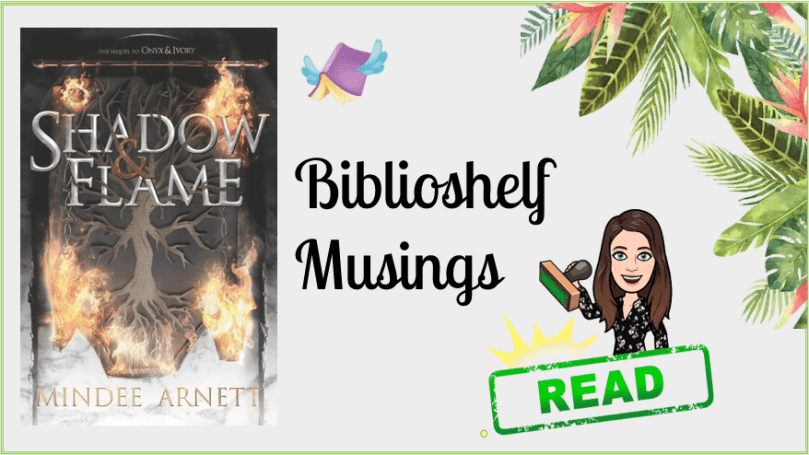
Biblioshelf Musings: Shadow and Flame

Howdy Bibliofriends!

This week’s Biblioshelf Musing is Shadow and Flame which is the sequel to Onyx and Ivory by Mindee Arnett. If you follow my other posts you’ll know that I’m not that great at keeping up with sequels. That being said, in my new little world of trying to maintain good ‘atomic habits’, the motivational need to clear some series space on my shelves prompted me to add Shadow and Flame to my birthday book haul.
🚨 There may be some spoilers ahead for the first book in the series but if you want to read one of my very early reviews then you can find my thoughts on Onyx and Ivory here.


Book: Shadow and Flame by Mindee Arnett
Genre: Fantasy / YA
Publication Date: 4th June 2019
Publisher: Balzer + Bray
Pages: 482
Rating: 📚📚📚

Synopsis (from Goodreads)

From acclaimed author Mindee Arnett comes the thrilling conclusion of the stunningly epic, action-packed, and romantic fantasy adventure about a powerful girl possessed of strange magic, the outcast prince she loves, and the kingdom that has torn them apart.

Kate and Corwin are on the run, desperate for allies in a new world of war among the kingdoms of Rime. As the book opens, Kate suffers a massive loss, one that will shape the struggle for freedom of all wilders and magic folk—that is, if Kate can learn to control her own power.


The World of Rime

Wow, it felt so good to be back in Rime. I have to say that in a bookish world swamped with lots of medieval-style fantasy settings, the Kingdom of Rime felt really homely and not overdone. To be honest I think the setting may be one of my favourite parts of the whole novel. In Shadow and Flame we get to do a little more exploration of Seva and the Mistfold which is where the story kicks off. I can’t quite describe why I like it so much but the references to everweeps and the mysterious statues all just add to it being a nice place to spend some reading time in my head. Finding out the source of the Wilders’ magic and it’s link to the kingdom was one of those niche little things that I enjoyed whilst reading. I’m really hoping that we can come back to this world someday just to explore the places on the map that we didn’t really see.

Signe and the Esh Islands

One of those places is the Esh Islands where Signe is from. Signe is such a mysterious character and she has a really unusual appearance with ruby-like gems surrounding her mouth. As part of the Furen Mag, we find out much more about Signe’s identity throughout the book, however the ending left me feeling like there was a little more to this character and her heritage that I wanted to know an awful lot more about. We finally discover the secret of the mystical Black Powder, but it all just leaves me wanting a spin-off series about Signe and the Furen Mag.

Paragon and Uror

The Paragon and the Uror are central devices used to carry out the plot and battle between good and evil in the Rime Chronicles. It’s quite hard to talk about them without giving away major spoilers but as far as ‘roles for heroes’ go, these were pretty effective and I liked the symbolism of the black/white themes that accompanied their descriptions.  They were both fairly predictable within the story but I really did enjoy the storytelling around the way they were represented – who doesn’t love a magical horse right?!

To Sway or not to Sway

Kate’s wilder ability is to control people’s minds with Sway. The book goes into great detail about how the ability to invade someone’s mind or force them to do things against their will comes with a heavy burden and a price to pay. This is part of a major conscience battle for Kate and I like the way the author explores the way her use of her wilder ability affects some of her closest friendships – it’s not often that we get to see the psychological ramifications of something like this taking a key focal part in a fantasy tale.


All in all, The Rime Chronicles were a nice, fun read. The characters were nice, the plot was nice, the magic system was nice – nice, nice, nice. I occasionally read parts of the story and had a deja-vu moment as if I had heard of that ‘blackened, poisoned hand’ somewhere before… but on the whole, it was an enjoyable story which I’m definitely glad to have picked up and completed. Predictable in places, slightly rushed at the end after the final battle and although I feel like I’m ready to say goodbye to the world of Corwin and Kate, I’m definitely not quite ready to part with the whole of the Kingdom of Rime and would look forward to more books from this quaint little fantasy-fictional world.


Have you read the Rime Chronicles? Would you rather be a Wilder and pull your magic from the Earth around you, or a Magist who creates magic through making magical orbs and portals? I think I’m definitely more on the Wilder side. As always, drop me a comment to chat!

T xx

Biblioshelf Musings: Atomic Habits

Yoohoo Bibliofriends!

This week’s Biblioshelf Musing is from a non-fiction self-development style book called Atomic Habits. This is by far one of the most useful books I have ever read (listened to). I originally purchased it as a friend had rated it 5 stars and referred to it on one of those ‘books that saved my life’ tweets.


Book: Atomic Habits by James Clear (Audiobook)
Genre: Non-Fiction, Self-Help: Personal Development
Publication Date: 18th October 2018
Publisher: Penguin Random House Audiobooks
Pages: N/A
Rating: 📚📚📚📚📚

Synopsis (from Goodreads)

In this highly practical guide, today’s leading expert on habit formation lays out a proven system for making good habits inevitable and bad habits impossible.

Atomic Habits asks a simple but powerful question: How can we live better? We know good habits build better lives, but it’s easy to get thrown off course–trying to lose weight when we eat poorly and sleep too little; spending when we want to save. What makes some habits easy to stick with while others fail?

Filled with self-improvement tips based on proven scientific research, Atomic Habits reveals how altering our small daily habits can transform our lives for the better. This easy-to-understand guide uncovers the hidden forces that shape your behavior–everything from mindset to environment to genetics–and shows you how to take control of them. Organized around the Four Laws of Behavior Change, this book will show you how to apply each one to your life and work. In the end, you’ll get a simple method for building a repeatable and sustainable system for success.

James Clear, author of a wildly popular blog with more than two million readers per month, is known for his ability to distill complex topics into an easy-to-understand format. Now, he breaks down the art and science of habit formation into its most fundamental state, giving us a playbook for success. Sharing stories of his own achievements alongside those of star athletes, business leaders, artists, people who have kicked addiction against all odds, and even folks who just wanted to stop biting their nails, Clear proves that your goals are within reach–as long as you start small.

If you want to transform your habits–or those of your family, team, or community–then you want to read this book.


Now I have to confess, during the lockdown, my reading of physical books massively increased so I kind of forgot that this audiobook existed for a while and ended up parking it on a digital shelf having only listened to a small portion. Since the Monday-Friday work resumed at school and the pressures of teaching life unfolded, the motivation to try and get through some of the already unfinished books resurfaced and I decided to try and make it a habit to resume the listening of my audiobooks.

Atomic Habits is told in a clearly structured way surrounding the ‘4 laws’ for good habit-making. Each chapter takes you through the strategies of how to develop a good habit and then the book gradually builds up chapter by chapter into how to ingrain those good habits seamlessly into your lifestyle. The chapter summaries at the end repeat the key themes and actions to take forward and almost forms as a workbook or step-by-step guide into what you need to do next to make your own atomic habits a reality. The benefit of having this as an audiobook was that listening to those steps being repeated over and over again made them get stuck in my head almost like the way you can recall the lyrics to your favourite songs.

Clear also goes a step beyond just the formulation of habits and habit strategies by detailing some of the underlying scientific principles to explain how habit formation works in your brain and how to develop good habit behaviours/disciplines in your life. Coupling this with case notes of famous celebrities or renowned organisations (Steve Martin, British Cycling Team, Katie Ledecki) as well as ordinary people in high-powered business jobs, Clear gives first-hand examples of how habit-building and application can lead you into creating a more successful or proactive lifestyle. While listening, my mind was automatically zooming into the type of habits I could be using within both my personal life and at school.

After finishing this book, I’ve definitely been applying some of the strategies I’ve learned into my life. I’m starting (as recommended) with smaller achievable habits which I can then ‘habit-stack’ into hopefully ticking off some of my goals. As a stationery addict of course this has come complete with pretty notebook, colour-coding pens and highlighters, stickers and washi tape etc… At the minute, I’m definitely feeling more motivated now that I’m taking some proactive steps into living more of a productive life (us Taureans do have laziness listed as one of our character traits…!). Time will tell whether or not those atomic habits start to just become part of the normal daily life.

If there are elements of your life or world which you wish were more successful or you want to feel more content with then I strongly recommend buying and reading this book. If you’re even wavering over it, a really good place to start would be James Clear’s website which contains a great deal of information about the book and also features some excerpts and chapters to give you a flavour of what it’s like. I am definitely looking forward to putting what I’ve learned into practice. One of the habits I really want to build upon is my engagement with other blogs and people on Book Twitter so those have now been factored into my habit tracker. There’s also a few health/personal elements that I’m working on such as making sure I text one different friend each day, just to check-in on them and say hello (I’m quite at bad at that!). Fingers crossed that it starts to work – I’ll have to update you in my July update to see if it’s working. Here’s to a more habit-centred, productive lifestyle!

James Clear WebsiteAmazon | Waterstones |


Do you feel like you need little more order in your life? What bad habits are you guilty of committing? What kind of good/productive habits would you put into your habit-tracker? As always, drop me a comment to chat!

T xx
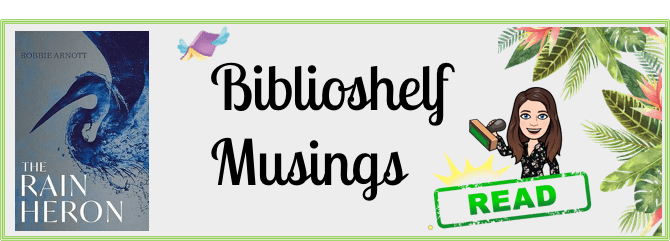
Biblioshelf Musings: The Rain Heron

Hey Bibliofriends! Happy 1st July!

This week’s Musings come from a wonderful book I recently acquired through NetGalley called The Rain Heron. Although it contains a serious message, a little magic and mythology are interwoven through its narrative and I absolutely adored it!


Book: The Rain Heron by Robbie Arnott
Genre: Literary Fiction
Publication Date: 2nd July 2020
Publisher: Atlantic Books
Pages: 304
Rating: 📚📚📚📚📖

Synopsis (from Goodreads)

Ren lives alone on the remote frontier of a country devastated by a coup. High on the forested slopes, she survives by hunting and trading – and forgetting. But when a young soldier comes to the mountains in search of a legendary creature, Ren is inexorably drawn into an impossible mission. As their lives entwine, unravel and erupt – as myth merges with reality – both Ren and the soldier are forced to confront what they regret, what they love, and what they fear.

A vibrant homage to the natural world, bursting with beautiful landscapes and memorable characters, The Rain Heron is beautifully told eco-fable about our fragile and dysfunctional relationships with the planet and with each other, the havoc we wreak and the price we pay.


The Rain Heron is a stunningly decadent tale of mythical creatures and the price our humanity pays on the natural world. Billed as an ‘eco-fable’, the story of The Rain Heron is centered around a legendary bird made of water that can affect the weather of the land surrounding it – and by proxy, the impact that has on humans. The story follows Ren, a woman who lives and forages in the forests, and Lieutenant Harker who has been charged with finding and capturing the heron.

From the outset, the vivid language and opulent vocabulary woven through the pages makes for an atmosphere rich in imagery. I loved the tone of the storytelling and felt as though my senses were heightened as I witnessed Arnott’s landscape inside my brain in HD technicolour.

Being told through four non-linear parts of differing perspectives enables the reader to explore the various personality traits of the main characters and see their unique interpretations and views of the world. Although each character has different motivations, the main message is crystal clear – looking after nature is everyone’s responsibility and we all need to do our bit to prevent the disastrous ramifications that its desolation will bring upon our planet.

I have to admit, when Part Two hit, I did wonder if this were more a compilation of tales rather than just one story but by sticking with it and moving on to the remaining parts, the story neatly weaves itself together and further explains certain characters’ justifications for their actions. This notion of consequence is seen mostly through Lieutenant Harker (whether she is directly affected or an observing bystander) and I really enjoyed the way her character arc changed and developed throughout her journey in the story.

I’d love to think that a rainbow heron existed once upon a time. The bird itself is a powerful symbol within the book and gave the novel a parable feeling – almost like an ancient myth you would use to explain to children where rain comes from. The quest for the legendary creature made me feel as if I was reading the adult Pokémon novel I’ve been waiting for all my life mixed in with a highly poignant ecological sentiment.

Arnott has a standout voice and has spun such a timeless, relevant novel for our times. I found it deeply moving and it really made me consider the balance we need to find between our human world and our natural world. Rather than keep taking from nature, we need to find ways in which we can give back and preserve the heritage of our air, lands, seas and all creatures great and small for future generations. If you love tales from the environmental world which resonate a true, meaningful mantra then you need to take a leap into the world of The Rain Heron!

Big thanks to NetGalley, Atlantic Books and Robbie Arnott for providing me with a free copy in exchange for an honest review.

Atlantic Books | Waterstones | Amazon |


What’s your favourite ecological tale? Do you have a favourite myth or legendary creature? Would you like to live in a world where Rain Herons could exist? As always, drop me a comment to chat!

T xx
Biblioshelf Musings: My Fence is Electric: and Other Stories

Happy last Wednesday in June Bibliofriends!

Short stories are an art of their own. To do it well is some achievement, but to do it so well that it becomes powerful enough to leap off the page into your bookish heart is something else entirely… It’s safe to say that Mark Newman is a master of the short story art form.

My Fence Is Electric: and Other Stories is an anthology full of award-winning stories that deal with a lot of the macabre sentimentalities of everyday human existence. Dysfunctional families are actually quite normal nowadays; we don’t always know what goes on behind closed doors; many of us have parts of ourselves that we’d rather change or adapt. In places, Newman writes parables of bygone childhoods for reminiscent adults – others form as eerie ghost stories of the living – literary brilliance right up my street!


Book: My Fence is Electric: and Other Stories by Mark Newman
Genre: Short Stories
Publication Date: 18th February 2020
Publisher: Odyssey Books
Pages: 162
Rating: 📚📚📚📚📖

Synopsis (from Goodreads)

A housing estate is in shock following a child’s disappearance. A girl and her invisible friend go their separate ways. A father and a son bond over Post-It notes. A single father and his daughter have different approaches to the disappearance of their dog. A father finds his way to coax his agoraphobic son back out into the world.

My Fence is Electric and Other Stories is a collection of award-winning short stories looking at those moments in life that fizz with the electric intensity of change.


Many big themes (love, hope, freedom, conservation, illness, tragedy and change) are represented in these stories and Newman has such a wonderful way with words and descriptions; it really appealed to the inner logophile within me. Here are some of my personal favourites:

Before There Were Houses, This Was All Fields – Living in a rural area, I can relate majorly to our fields turning into building sites. This story opened Newman’s collection in a way which sets the tone for the whole compilation. The spooky imagery of the fairytale street names followed by evil and the likening of houses to skulls with their concrete breeze blocks and no windows for eye sockets was exceptional. You’re reminded that this story could so easily have been something you watch on the evening news. In a world with an expanding population and increasing housing need it’s an apt nod to what humanity has concreted over.

Little Yellow Squares discusses the way we can be talking about the same thing but really be having two entirely different conversations – all I can say is, I wish my post-it notes did what they do in this story!

We Sink When We Swim – I love the symbolism of the swimming pool in this story. The way it represents a journey, growing old, being lonely and the metaphorical way it considers what is really beneath the surface of the water and our emotions.

Butterfly Farm – So short yet so sweet. Without spoilers, I love the way the way freedom is represented and parodied between the butterflies and ‘she’.

My Fence is Electric focuses on the way we try to protect ourselves from heartbreak, I’ll never look at an electric fence again without thinking of this story.

Rosa is Red, Violet is Blue centres around our identities, how we strive to be someone different and the change we want to bring about in ourselves. I enjoyed the way the colours represented differing attitudes and personality traits.

I read My Fence is Electric: and Other Stories during the coronavirus lockdown and it strikes me as the perfect ‘stay-at-home’ book to remind you of ‘real people’ during this time when we can’t see our friends and families as we usually would. It’s a reminder that we are all unique, we all have little worlds inside our own heads, yet we are all out here on planet earth trying to survive through this together whilst being socially distanced and apart. In my own little way, the stories reminded me slightly of a bookish version of my favourite Florence + the Machine songs, probably another reason why I thoroughly enjoyed it. This collection really does have something for everyone, you can dip in and out of the stories at any time or read them through in their published entirety.

When I think of the greats of the short story genre, I often think of the renowned anthologies: Raymond Carver’s What We Talk About When We Talk About Love; Katherine Mansfield’s The Garden Party and Other Stories; Angela Carter’s The Bloody Chamber – I will now definitely be adding Mark Newman’s My Fence Is Electric: and Other Stories onto that list as well – it deserves its place there.

A big thank you to Odyssey Books for getting in contact with me via Twitter and providing me with a free copy of this book in exchange for an honest review. An extra big THANK YOU to Mark Newman for bringing these incredible stories into my life! ☺️

Even if you don’t normally read short stories, there is bound to be something for you in this collection – I would wholeheartedly recommend you read it!

Odyssey BooksAmazon | Waterstones |


What’s your favourite short story ever? Do you prefer longer short stories or short short stories? As always, drop me a comment to chat!

T xx

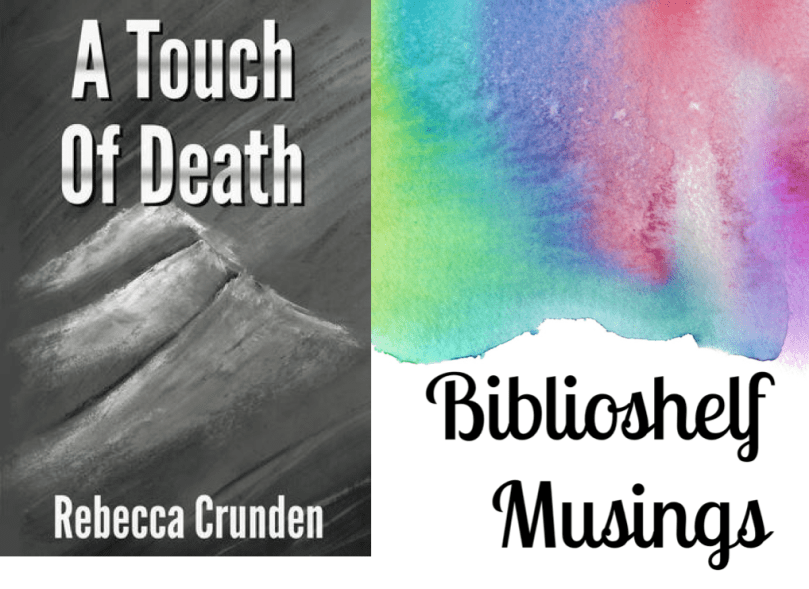
Biblioshelf Musings – A Touch Of Death

Good morning Bibliofriends,

I was overjoyed and thrilled when Rebecca approached me to read and review the first book in her Outlands Pentalogy. A Touch of Death follows the story of Nate and Catherine as they embark on a journey as wanted criminals through the Kingdom of Cutta. After running into a spot of trouble in the mountains, Nate and Catherine become infected with a mysterious disease and are then wanted for an investigation into their strange circumstances. A notorious criminal and dissenter, the last thing Nate wants is to submit himself to interrogation at the hands of a department where its inmates seem to vanish. The pair decide to evade capture and go on-the-run seeking sanctuary and a new life in The Outlands. It’s only when the disease seems to become more deadly and impact upon their health, do the pair face a tricky decision: continue to seek a new life and possibly die trying… or return to the heart of the kingdom hoping to find an antidote without being detained and condemned.


Book: A Touch of Death (Book #1 – The Outlands Pentalogy) by Rebecca Crunden
Genre: Science Fiction, Dystopian, Fantasy, Romance
Publication Date: 24th Feb 2017
Publisher: CreateSpace Independent Publishing Platform
Pages: 308
Rating: 📚📚📚.5

A Touch of Death is an intriguing, dystopian thriller which left me curious as to how the series is going to develop next. I absolutely loved the attention to detail at the world-building in the Kingdom of Cutta. The fact that this place has a map won me over from the start, but the drip-by-drip feed on information and detail helped me to construct the kingdom in my mind. It really helps me to become invested into a place if I feel like I can visualise it in my head. Whilst the Kingdom of Cutta clearly has that dystopian feeling with the mention of radiation destruction, rabids and mutants, the characters, setting and feel of the whole novel gave off a brilliantly balanced futuristic fantasy vibe. By breaking the novel down into parts rather than chapters, it was clear to see how each element of the plot linked into the next and helped the story to flow.

Right from the off, it was immediately clear that Crunden is an author who isn’t afraid to take a risk. The lashing torture during the opening scene was a fairly harrowing reminder that A Touch of Death is firmly cemented in the adult section of the genre. It was a powerful opening prologue and helps you to understand later on why the characters fear Redwater prison so much.

I adored the city of Talon and it is now on my literary travels bucket list. The no-judgements imposed upon visitors as long as you follow the rules, time spent in the stunning library as well as the glorious sounding architecture and food makes it seem like the perfect place for communal living and offered up a stark contrast to the other places we’d visited in Cutta so far which were heavily regulated and policed.

The characters Tove, Zoe and Evander were a welcome introduction part way through the story. They provided some folklore, humour and helped to freshen up the plot of two characters on a quest to escape the kingdom. I really liked the different dynamic they added to the story.

Towards the end, Catherine’s thoughts that the world would be a better place without the strict and harsh ruling of Crown and Council (government) that dominate all in the Kingdom of Cutta, seemed incredibly poignant in today’s modern world and in particular the current challenges and opinions posed of governments during this global pandemic. I seem to have an affinity with these types of storylines due to my own personal political stances and views so Catherine’s perspective was really relatable.

The ending of A Touch of Death is neatly lined-up for the next book in the pentalogy. I would say that I think I needed a little more information throughout the story as to why Nate is so against Crown and Council, other than just his personal views and the treatment put upon him. I feel this was hinted at slightly, that there might be some other underlying reason there, but I wanted this to just be slightly more evident and almost leave me burning (pun intended!) as to what is going to happen next as the story doesn’t end on a cliffhanger or dramatic twist. Nevertheless, I’m still intrigued to explore more of the Kingdom of Cutta and learn the fates of characters who have been left with such a harsh hand dealt to them all – I’ll definitely be downloading the sequel!


You can connect with Rebecca at her website, Twitter or Goodreads.

You can find out more about The Outlands Pentalogy here:
Goodreads | Amazon

What’s your favourite dystopian book? Do you think you’d prefer to live in a world 1000 years from now or are you happy in 2020? As always, drop me a comment to chat!

T xx

Biblioshelf Musings – Descendant of the Crane

Hey Bibliofriends,

I have probably repeated this way too many times already but… I got my first accepted requests on NetGalley and THIS was one of them!!!! Partying Face on Apple iOS 13.3  I had to try and stop myself from squealing with excitement as I’d made the mistake of checking my emails on my phone whilst being on a Zoom meeting and I don’t think that would have gone down too well with our HT… anyway…

This book has been on my radar since it was first released back in 2019. I could only ever find it in hardback format on Amazon / Book Depository with weird shipping and prices. I’m not sure whether it had a small release or what, but when I stumbled upon it whilst browsing NetGalley I couldn’t help but push that request now button – it was like my lucky day when the request was accepted! Thank you to Titan Books and NetGalley for this e-arc in exchange for an honest review.


Book: Descendant of the Crane by Joan He
Genre: Science Fiction & Fantasy / Teens & YA
Publication Date: 16th June 2020
Publisher: Titan Books
Pages: 416
Rating: 📚📚📚📚

Descendant of the Crane is an enchanting fantasy novel which centres around the murder trial of the King of Yan. His daughter, Hesina, will go to extraordinary lengths in order to solve the mystery of her father’s death whilst trying to prove her place as Queen and help fix her broken country. In a land where the magic soothsayers have been outlawed and are forced to remain hidden in plain sight, Hesina must battle against her Ministers, her family, her allies and even kingdoms in her quest for the truth. This novel was everything I look for when it comes to a fantasy tale. The plot was very well-developed and explained with intricate detailing and nods to ancient Chinese culture and heritage. Twists and turns came from everywhere and nowhere and left me wondering where this beguiling story could possibly end up. If you love a bit of political intrigue, betrayals and deceptions from every corner, a hint of magic and mystery all set in a stunning Oriental inspired world then you should definitely read this book!

Pace

Now to me, the pace of this novel can be explained a bit like a rollercoaster:

Leaving the gates = learning about the world of Yan, the history of the sooths and why they were outlawed.

Going up… = the takeover of the Eleven 300 years ago and the Tenets which are the laws the Kingdom is ruled by – not to mention the cast of characters…

…Still going up = the King’s mysterious death is revealed and Hesina desires for a trial to take place…

Nearly at the top = people within the palace are being put on trial and we learn more about Hesina’s family, her personal struggles and the Kingdom…

Don’t forget to look outside the carriage = It feels like we’ve come a long way through the story and we’re still getting to grips with all that’s going on but there are dramatic actions and events for you to admire in the surrounding landscape.

We’ve reached the top = everything seems to be drawing together. The plot begins to knit together in your mind as you see the rest of the track and you think you know where the novel is going…

Whoosh = you plummet down the drop, revelations spring from each side – there’s shock, there’s mystery, you didn’t even think ‘that’ character could ever do such a thing!

Then – darkness —– You’ve gone through a tunnel and suddenly the plot you thought you formulated in your head has been blown to smithereens (trust no-one!) – you come out of the tunnel and through the loop the loop back over another mini-incline, drop down and BAM the story crashes to a halt – cue The Epilogue…!

Pace is definitely something which develops and quickens the further through the novel you go. Whilst this is pitched as a standalone, I believe that Joan He has said that the ending of the story leaves room for companion novels set in the same world and after that ending, I would say that they are definitely needed, wanted and welcomed! I imagine this could follow a pattern similar to The Illuminae Files or A Curse So Dark and Lonely where the sequels follow the extension of the plotline based within the same world but with different leading characters.

Characters

The characters in the novel have fairly complex relationships with each other meaning that you’re not sure who you can trust or rely on. This adds a good deal of suspense to the novel and is one of the key drivers for the frequent twists and turns that come jumping out of the plot. Whilst this is great for keeping me invested into what is happening with the story, it did leave me feeling a little ambivalent towards some of the characters. Hesina, was really well-developed and the depth of explanation and narration from her story helped me to understand her feelings and perceptions. Aside from the main storyline, familial relationships form a big theme throughout the novel. Hesina constantly struggles to balance her feelings and bonds with her mother, brother, step-brother, adopted siblings and even the ghost of her father and the legacy he left her. The pressure of maintaining those relationships brought a realistic element to the story and made Hesina seem slightly more relatable to me as a reader (whoever has a totally normal family right?).

World-Building

The world-building in the novel is revealed through both flashbacks and the character narration. There is a fair amount of the Kingdom of Yan’s history to take on board in the story which although slowed the pace, helped to weave together the rich oriental world that the characters were living in and set the scene perfectly for the uprisings, revolts and trial that form the main action within the story.

Motifs

One of my favourite things to pick out in books is little niche motifs. The Imperial Palace is set on a whole labyrinth of tunnels, secret passageways and caves. Although they are not necessarily a main part of the story, they do allow for some key events to take place and I loved this little story element.

Death by a Thousand Cuts

One, teensy-tiny minor thing which massively distracts me when reading any novel is when a writer has a word or phrase that they repeat endlessly through their writing. Descendant of the Crane was no exception. The phrase ‘death by a thousand cuts’ was repeated approximately 14 times and whilst I understand the writer is referring to Lingchi, a torture technique and form of execution used in Ancient China, there are no actual scenes where this even happens in the book. Additionally, although I’m a Taylor Swift fan, every time I read that phrase I constantly had her song of the same name buzzing round my head like it was stuck on a constant loop. So yes, this was rather distracting and slightly irksome as it took my focus away from the story due to my little niggling rage.


What I liked:

  • the depth and level of detail Yan and it’s history is described in.
  • the characters were likeable and I was invested into finding out what really happened to the King.
  • The plot is intriguing and full of twists, turns and suspense which hooked me
  • Hesina’s relationship with her mother and the way it was developed throughout the book.
  • The folklore and background relating to the Eleven and the Tenets they created as society rules and regulations.

What I would have liked a little more of:

  • For me, the ending needed slightly more explanation to balance it with the rest of the book – whilst I liked the Epilogue, the novel seems to be cut dramatically short, which would be fine if there was a sequel definitely announced but I’m not fully sure whether this is the case.
  • The idea of the crane is quite prevalent throughout the story and there is a nice element of folklore surrounding it but I think this needed to be a little more explicit in the closing parts of the novel, particularly in how it relates to Hesina and her family especially seeing that it is the title of the book.
  • I still have a few too many questions about characters and why their circumstances are the way they are and what may happen to them now that the novel has finished – if there were already a sequel definitely pegged in the works then I’d hope that the questions I’m left with would be answered.
  • Not a little more, but a little less repetition of ‘death by a thousand cuts’ – I understand where it comes from and why it’s there but I found it personally rather irritating.

If you enjoyed State of Sorrow, Forest of a Thousand Lanterns or simply enjoy well-written, intriguing and complex Asian-inspired fantasy stories then you are highly likely to enjoy Descendant of the Crane. You can find out more about the book here:
Goodreads | Waterstones | Amazon |

Have you read Descendant of the Crane? If Asian-inspired fantasy stories are your thing what books would you recommend? Do you have a buzz-phrase which annoys you when reading? As always, drop me a comment to chat! 🙂

T xx


#BiblioshelfMusings – The Space Between Worlds

Hi Bibliofriends,

Hope you have been having a good week. This week’s review post is from my first-ever approved NetGalley title! I had so much fun reading The Space Between Worlds and couldn’t believe in when Hodder & Stoughton approved me for this book so big thanks to them, Netgalley and Micaiah Johnson for providing me with this e-arc in exchange for an honest review.

How would you feel if there were 382 versions of Earth out there in the multiverse each with a doppelganger of ‘you’ on it? How would you then react if you could travel to 375 of those Earths because ‘you’ no longer existed on them? Would you get Imposter Syndrome? Or would you be thrilled at the opportunities that living countless new lives could bring?

The Space Between Worlds is an insightful yet gritty Sci-fi novel which seeks to answer these questions whilst at the same time contemplating what it means to be ‘you’ in a multiverse where multiple versions of you could possibly exist.

Below:
Book Details
Mini-Musings (Review in brief)
Book Synopsis
Detailed Musings (Spoiler-free review)


Book: The Space Between Worlds by Micaiah Johnson
Genre: Science Fiction
Publication Date: Expected on 4th August 2020
Publisher: Hodder & Stoughton
Pages: 336
Rating: 📚📚📚📚

Mini-Musings (review in brief)

I don’t tend to read much Sci-fi and usually stick to the more fantasy side of the wider genre but the blurb for The Space Between Worlds intrigued me so much that I had to read it. The world felt really dystopian and the balance between the shiny, rich Wiley City compared to the rural wastelands was reminiscent of the divided world in The Hunger Games. It took me a little while to get into it as I felt the need to concentrate on what was happening, especially with so much talk of multiple versions of one person flying around, but the further I traversed into the story, the clearer I understood how this multiverse worked. There are so many dimensions and levels that each chapter was like peeling back another layer of the onion. The Space Between Worlds has plenty to offer both those looking for a sci-fi mind-bender of multiple earths, as well as those looking for the morality and human elements behind the storyline. It was a truly captivating read and I’m so glad and thankful that I was given the opportunity to read it.

Synopsis (From Goodreads)

Reasons Cara has died:

– The emperor of the wasteland wanted to make an example of her mother and started with her
– One of her mother’s boyfriends wanted to cover up what he did to her
– She was born addicted and her lungs didn’t develop
– She was left alone, and a stranger came along
– The runners came for a neighbour and she was in the way
– The runners came for her mother and she was in the way
– The runners came for her boyfriend and she was in the way
– The runners came for no one, serving nothing but chaos and fear, and she was what they found
– Her mother left her alone in a shed while she worked or got high and she fell asleep alone and hungry and forever

Reasons Cara has lived:

– She doesn’t know but there are 8.

The multiverse business is booming, but there’s just one catch: no one can visit a world where their counterpart is still alive.

Enter Cara. Of the 382 realities that have been unlocked, Cara is dead in all but eight

But on this earth, she survived. Born in the wastelands where if a basic lack of resources didn’t kill you, violence would, Cara is happy to reap the benefits of a job and a safe place in the city to call home.

But when one of her eight remaining doppelgangers dies under mysterious circumstances, Cara is plunged into a new world with an old secret. What she discovers will connect her past and future in ways she never could have imagined – and reveal her own role in a plot that endangers not just her world, but the entire multiverse.


Just like the multiverse itself, the mixture of characters, world-building and themes gave The Space Between Worlds many layers which I felt neatly came together at the end. There was action, adventure, deception, angst and romance as well as overarching themes which complemented to a bigger, more philosophical picture. I came to increasingly like the main character ‘Cara’ and understand her viewpoint on life the further into the story I got. Seeing it through her eyes allowed me to empathise with her character and my connection to her grew more and more as parts of her past and history were revealed.

At the start, I admit it took me a little while to understand how the multiverse and traversers’ abilities to walk between worlds actually happened. This is not time travelling, there are no rockets or spaceships involved, it’s more a sense of transportation from one Earth to another. The ‘science’ behind this is explained more as the novel develops but I loved that it wasn’t reliant on my knowledge of astro-/quantum physics just to keep up – it’s the story that is the main focus here. The presence of Nyame, who is almost like the God protecting the spaces between, helped to balance the scientific with spirituality which added a thought-provoking dimension to the narrative and transformed it from some of the more traditional space-travel novels out there. This balance is neatly woven throughout the story.

The many versions of Earth helped to highlight different real-life elements which pose as barriers in today’s society. The rich and elite live in Wiley City where they thrive with protection, wealth and opportunity; Ashtown showcases the hard-graft and poverty that comes with surviving in a rural wasteland. The idea of the Eldridge Institute (where Cara works) monopolising interstellar travel hints at corporationalism and the sense that totalitarian control and data-tracking are steadily becoming major parts of our everyday human existence. The Space Between Worlds also seems to throw the usual rules of altering the past/future or meeting your doppelganger out of the window. In-fact the whole plot ends up being central to the reliance of this breaking of the rules adding an interesting aspect to the whole narrative.

The novel tackles many key issues relating to mental-health such as loneliness, identity and grief. Feeling lonely on one Earth can be painful enough, but loneliness in a multiverse of 382 of them? Perhaps there’s no word for that. This feeling was made poignantly clear through Cara’s perspective. Her deep-rooted desire to find a people and place where she truly belongs runs through the heart of the entire novel. It is her exploration and experience of these ideals which enables the reader to begin to relate to her character and see her as more than just a one dimensional world-walker.

With each chapter, a new jigsaw piece was put into place to help me understand the story. There was enough action and explanation to keep me in a state of curiosity as to where the plot was going and how it could possibly end. I felt that the finale wasn’t as high-stakes and action-packed as I was expecting, especially given a previous scene in the novel, however reflecting on this I now see that it didn’t need to be. All of my questions were answered yet still leaving me some room to have my own reader speculations about where the characters’ lives could go next – in a way, that’s one of my favourite types of endings.

If you’re just starting out into the sci-fi genre, or you prefer your sci-fi novels with a little less spaceship and a bit more character development, then you would probably would find an awful lot to enjoy in The Space Between Worlds. This novel has so much to offer a reader and the constant references into what lies in the spaces between things – be it worlds, people, places, identities, emotions… completely encapsulates and resonates in the entirety of this book. There were so many quotations and phrases I highlighted which I found to be powerful and moving. For me that’s a sure sign that I thoroughly enjoyed everything The Spaces Between Worlds gave me.


You can find The Space Between Worlds and get your Doppelganger-fix here:
Goodreads
Amazon
Waterstones
Book Depository

Thanks for reading! Happy Wednesday everyone!

T xx

Biblioshelf Musings – The Shadows Between Us

Howdy Bibliofriends!

This was my first time reading anything by Tricia Levenseller and if it’s anything to go by then it definitely won’t be the last time I read anything by her!

I received The Shadows Between Us in the Feb 2020 FairyLoot Rulebreakers box and can definitely see how this book fitted into the brief. Neither Alessandra or the Shadow King play by the rules or conform to convention. Billed as a Slytherin Romance I was expecting lots of sneaking, cunning and trickery throughout this book – let’s just say, it did not disappoint!


Book: The Shadows Between Us by Tricia Levenseller
Genre: Fantasy, Romance (YA)
Publication Date: 25th Feb 2020
Publisher: Feiwel and Friends [FairyLoot Exclusive]
Pages: 326
Rating: 📚📚📚📚

Synopsis from Goodreads:

Alessandra is tired of being overlooked, but she has a plan to gain power:
1) Woo the Shadow King.
2) Marry him.
3) Kill him and take his kingdom for herself.
No one knows the extent of the freshly crowned Shadow King’s power. Some say he can command the shadows that swirl around him to do his bidding. Others say they speak to him, whispering the thoughts of his enemies. Regardless, Alessandra knows what she deserves, and she’s going to do everything within her power to get it.
But Alessandra’s not the only one trying to kill the king. As attempts on his life are made, she finds herself trying to keep him alive long enough for him to make her his queen—all while struggling not to lose her heart. After all, who better for a Shadow King than a cunning, villainous queen?


“They’ve never found the body of the first and only boy who broke my heart.
And they never will.
I buried Hektor Galanis in a hole so deep, even the devils of the earth couldn’t reach him.”

When your protagonist introduces the book with these lines, you know you’re going to be dealing with someone who oozes sass and feistiness. Alessandra absolutely delivered on this – imagine Downton Abbey’s Lady Mary mixed in with dash of Bellatrix Estrange and a hint of Anne Boleyn… that’s your girl!

Her determination to reach her goal was relentless and nobody was about to foil her plans no matter how powerful or what role they had at court; ‘hell hath no fury’ and all that…!

I enjoyed the change in Alessandra’s character as parts of her plan had to evolve and things didn’t necessarily go her way. She had to undergo a transformation of getting over past hurts and learning the art of compromise and teamwork. Although Alessandra’s personality comes across to the reader through narration and interactions with other characters, it also comes through in the way that she dresses.

Clothing in particular plays a huge role in this story. I love the way Levenseller picked one element of her world to focus on as the main source of description throughout. Rather than write huge chunks describing, castles, towns and kingdoms, Levenseller shows the reader the vibrancy and attitude of the Shadow King’s court through fashion. In a way, this was a brilliant move. I am a massive fan of world building and would happily read a book with an extra 150 pages just so I can get a clearer picture in my mind of the way the author wants us to view their creative universe – but to see the way in which changes at court or in people’s emotions/feelings were reflected through what they were wearing added a decadent feeling to the whole narrative. This also echoes the importance of fashion and clothing throughout history. Think back to Tudor times when certain colours and materials were only available to those with the right money for dyes and textiles; then fast-forward to the present day and think of how haute-couture is only available to those who can afford the price-tag or garner the right publicity and influence.

The plot-line was a relatively simple one to follow and with most of the narrative being dialogue, it really helped to speed up the pace of the novel and digest what was going on. In true Slytherin style, the amount of deceptions and variety of motivations from different characters helped to keep me guessing who was actually trustworthy right until the very end – but even then I didn’t think the ending would necessarily be as simple as it was.

If you like your romances with a hint of black magic, then The Shadows Between Us would probably be right up your street. This was a wickedly dark, entrancing read which had me gripped right from the first page. It is filled with secrets, court politics and a romance developed from deception. I enjoyed the way that Alessandra was a woman championing her equal rights and standing up for herself and what she believed in. She came across as a woman with ambition who was willing to work her ass off to get there, rather than stomp around pouting with a sense of entitlement. The romance between her and the Shadow King is one of my new favourite relationships from the fictional world – they are so well-suited to each other and I’m a little gutted that there isn’t a sequel just so I can see what happens next.


Have you read The Shadows Between Us? Would you recommend any other Tricia Levenseller books? What other Hogwarts House romance are you craving in your bookish lives? As always, drop me a comment to chat! 🙂

T xx

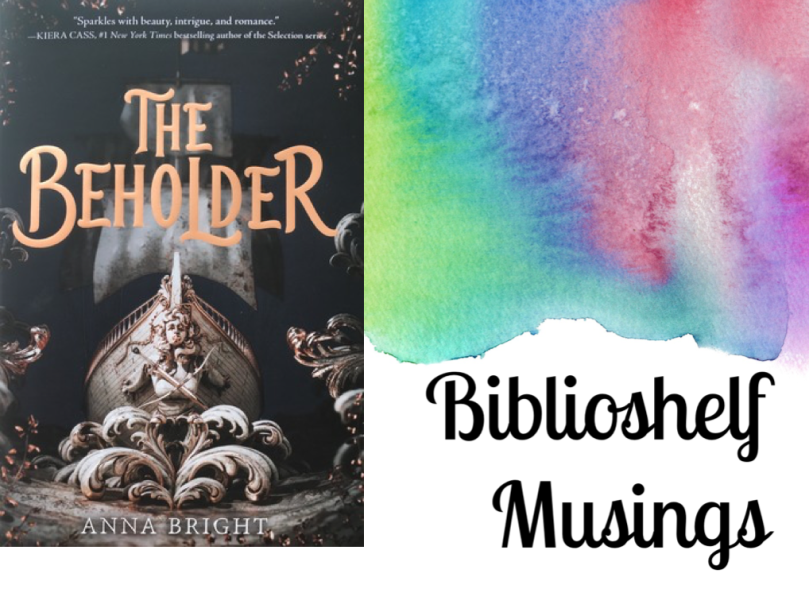
Biblioshelf Musings – The Beholder

Hi Biblioshelf Friends,

How is your week going? I have had lots of exciting book mail this week so I finally have enough to make a book haul post at the end of the month (for what feels like the first time ever!).

At the end of April, I finished reading The Beholder for the OWLs Magical Readthon last month (wrap post here if you’re interested!). I was so intrigued to get into this book and not just because my copy was the Fairyloot Exclusive edition with pink sprayed edges and rose gold foiling on the front. The idea of sailing off to different kingdoms to look for a suitor on a big ship sounded perfect for the prompt of a book set on the seas/coast. If you want a little sneak peek of the book then check out my #Friday56 post here!


Book: The Beholder by Anna Bright
Genre: Fantasy (YA)
Publication Date: 4th June 2019
Publisher: Harper Teen [FairyLoot Exclusive]
Pages: 429
Rating: 📚📚📚.5

Synopsis from Goodreads
Selah has waited her whole life for a happily ever after.
As the only daughter of the leader of Potomac, she knows her duty is to find the perfect match, a partner who will help secure the future of her people. Now that day has finally come. But when the night of Selah’s engagement ends in an excruciatingly public rejection, her stepmother proposes the unthinkable: Selah must set sail across the Atlantic, where a series of potential suitors awaits—and if she doesn’t come home engaged, she shouldn’t come home at all.
From English castle gardens to the fjords of Norge, and even beyond borders of the dreaded Imperiya Yotne, Selah’s quest will be the journey of a lifetime. But as she searches for her future husband, she realizes that her stepmother’s schemes aren’t the only secrets hiding belowdecks… and the stakes of her voyage may be higher than any happy ending.


The Beholder is a tale which revolves around the main character, Selah, having to travel throughout the world on her ship (The Beholder) to try and find a suitor to marry. Selah is the Seneschal Elect who hopes to take over the running of the Ptomac community after her father. Unfortunately, she also has an evil, pregnant stepmother who wants to be rid of her whilst her father is getting increasingly ill. Selah hopes that by finding an appropriate suitor to take home, she will be able to assume her place as her Father’s successor before it’s too late.

This wonderful tale serves as Anna Bright’s ode to fairytale heritage. Chapter dividers and inserts offer little instalments and snippets from well-know folk and fairytales which foreshadow the events coming forth. To add to that, some of the main companions on Selah’s journey are named after some of the most well-known storytellers such as Perrault and Lang. I loved these little touches.

I was intrigued that the main heroine hailed from Ptomac as I haven’t read many mainsteam novels from that part of the world. The Arbor hall seemed to emphasise the ways the Ptomacs value the land and this is echoed in Selah’s agricultural upbringing as she looks after her community as one alongside her people. Selah’s character was honest and genuine throughout the start of the book. Her determination and will to not be beaten and take up her rightful role to aid her father was the driving force throughout her narrative. Her experiences of far-off places and the new world unfolded as she travelled to each destination. It was clear to see her turmoil and naivety through the way the potential suitors each individually influenced her attitudes and decision making.

For me, the first part of the book was really intriguing. I enjoyed the sense of journeying through different lands to find a suitor. But somewhere between the first and second/third kingdoms, I got a little lost along the way. Whether it was because I found things slightly repetitive or needed a few extra plot twists and turns to keep me going, I’m not sure. The extent of the story in a snapshot, is a good one; however, the big build-up I was waiting for from the third kingdom, which was feared so much that Selah didn’t even want to journey there, didn’t seem to fully reveal itself. Maybe it will in the sequel.

Either way, Anna Bright’s writing is immersive and lyrical, characters have enough depth, mystery and suspicion for your allegiances to keep shifting and the insights into different territories draws up a brilliant fantasy world based on our own familiar planet. For me, the novel seemed to split itself into two parts. The first half of the book was exceptional and really pulled me into the story, the second half didn’t quite balance with that but I’m still very keen to see where Bright takes this story next.


Have you read The Beholder? Is it on your TBR? Or do you feel like you really need a sailing trip around lots of new kingdoms right about now? As always, drop me a comment to chat!

T xx

Biblioshelf Musings – The Flatshare

Hi Bibliofriends,

I recently read The Flatshare by Beth O’Leary. I kept hearing about this book across the blogging and social media world so when I came across it for 99p on iBooks, I decided to take a punt on it.

Synopsis [from Goodreads]
Tiffy and Leon share a flat
Tiffy and Leon share a bed
Tiffy and Leon have never met…

Tiffy Moore needs a cheap flat, and fast. Leon Twomey works nights and needs cash. Their friends think they’re crazy, but it’s the perfect solution: Leon occupies the one-bed flat while Tiffy’s at work in the day, and she has the run of the place the rest of the time.
But with obsessive ex-boyfriends, demanding clients at work, wrongly imprisoned brothers and, of course, the fact that they still haven’t met yet, they’re about to discover that if you want the perfect home you need to throw the rulebook out the window…


Book: The Flatshare by Beth O’Leary
Genre: Romance, Contemporary, Fiction
Publication Date: 10th April 2019
Publisher: Quercus
Pages: 400
Rating: 📚📚📚

This read was the perfectly relaxing, light-hearted novel I needed. I really like the uniqueness of Tiffy’s and Leon’s situation – even though they share the flat (and the bed) there is a strict no-meeting clause in their arrangements as they work and use the flat at alternating times. The little notes they leave behind for each other, even though they have never met, allows the reader to discover more about each character as their stories unfold. The dual narrative also compliments this perfectly – Leon has his own way of speaking by omitting some pronouns or determiners; it really does resemble the thought processes of (some) men and their actions/reactions to events happening around them. I like how Tiffy wasn’t the standard tall, thin, beautiful heroine yet also not a token of an overweight person trying to break the mould of literature. She was real, normal and so relatable (apart from her height, she’d definitely tower over me!). Her beauty came from both inside and out, and she wasn’t afraid to show off her passion for home-altered clothing and fashion.

Beneath the heart-warming tale of two people finding each other amongst their distinctive living arrangements is the story of both the dark and light sides of love. Proving that love traverses time and generations, Leon looks after an elderly gentleman called Mr. Prior and helps him to try and track down the long-lost love of his life and fellow war comrade Johnny White. This is paralleled against Tiffy’s past relationship with ex-boyfriend Justin and the traumas that she was faced with after her perception of their relationship drastically changed and she realises what Justin was truly like.  Then there is Richie, Leon’s brother who is facing an appeal for being wrongly arrested and incriminated – he adds a humorous element to the novel and allows for the theme of justice to thread throughout the tale. Not forgetting Gerty, Mo and Rachel who all contribute and add their own fun dynamics.

Beth O’Leary created such a wonderful mix of characters which I grew to be fond of and enjoyed spending literary time with. The Flatshare brought me humour, joy and a sense that even the most painful and vulnerable memories can be overcome with the right people around you to help. It also gave me my new, perfect dieting excuse… upper arm “cake weight”, which has inspired me to also come up with forearm gin weight, upper thigh chocolate weight, lower calf Doritos weight and ankle pizza weight – albeit perhaps not the healthiest influence I’ve ever taken from a novel!


Have you read The Flatshare? Do you have the perfect dieting excuse like Tiffy’s? As always, drop me a comment to chat!

T xx